Mark Mattson 12-10-2025
Mark Mattson
Why Does Water Deserve Our Protection? It’s Personal.💧
For over 25 years, I’ve been part of a collective of people fighting for a swimmable, drinkable, fishable future for Canada's waterways. I started as a lawyer, transitioning to a full-time Waterkeeper in 2001, determined to enforce environmental law. Yet, through all the legal battles and successes, one question kept surfacing that I found surprisingly difficult to answer:
"Why does water need your protection?"
The Insufficient Answer
It seemed easy to explain: Start with the factual, rational arguments.
Water is essential for life, making up nearly 70% of our bodies and 70% of the Earth’s surface.
We can’t survive a week without it.
We can’t build an economy or a nation without it.
Follow that up with the argument that clean water is a fundamental public right and we have a legal responsibility to protect it for health and security.
These are fine answers. But they are not the full story.
Certainly, I can’t honestly say these statistics are the reasons I became a Waterkeeper. If these rational arguments were truly compelling, we would already be fiercely protective of our water, just as we are of our children or our homes. We would make the sacrifices necessary to ensure our water is protected at all costs. The reality is very different.
The Great Disconnect
We tolerate pollution. We normalize disappearing fish, lost shorelines, depleted species, and toxic waste. We are numb to numerous drinking water advisories across Canada. We allow billions of litres of untreated sewage to flow into our lakes and oceans annually because we don't want to spend money to upgrade our infrastructure.
There is a profound disconnect between what we know we should do and what we do. We are taking our fresh water for granted. It is imperative we figure out why, so we can fix it before it is too late.
How We Lost Our Way
There was a time when we didn't take our water for granted. In the late 1960s, rampant pollution—including rivers catching fire and lakes ‘dying’—provoked a public outcry, and the government responded. In 1970, Canada created some of the strongest environmental laws in the world, establishing agencies, ministries, and science bodies to fix the problems. People stopped being the caretakers of their waters, relying on government agencies to solve these issues.
The personal connection that made it worth protecting in the first place began to disappear. Access to clean water became a privilege, and protecting the environment, a choice.
The laws created to fix environmental problems were quietly undermined. Every law and tool environmental lawyers and prosecutors used in the 1980s and 1990s to protect our water was rolled back, weakened, or removed. The Fisheries Act was gutted, and the Canadian Environmental Assessment Act was amended to no longer apply to many major projects.
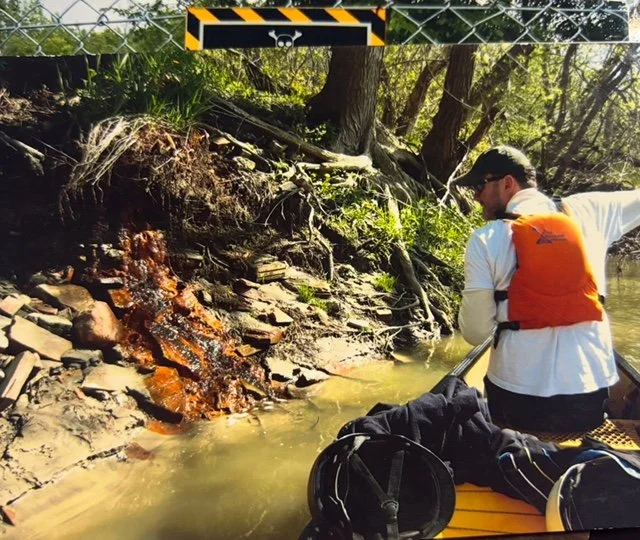
Our governments started solving our pollution problems by simply putting up "No Swimming", "No Drinking", and "No Fishing" signs. While the intention may have been to protect public health, the result was a further disconnection from nature and the normalization of pollution.

No Swimming Sign
Finding Our Watermark
So, the million-dollar question is: How do we make water worth protecting again?
While my legal career took a hit as the tools of the trade were destroyed, my passion as a Waterkeeper still burns bright. The inspiration for change came one night after watching the film “Watermark” by Edward Burtynsky, Nick de Pencier, and Jennifer Baichwal in St. John, New Brunswick. After the film, a reporter asked the filmmakers about their most powerful memories of being on the water. Each of them had a personal story—a moment that served as the inspiration for making the film. Even more amazing, everyone in the theatre had their own reason for protecting water and shared it at the after-party.
My story was simple. After school ended every year, my family would relocate to Wolfe Island for the summer, and I would spend every day fishing until dark. The St. Lawrence River taught me to swim, to fish, and to care about water. It gave me freedom, mobility, and a sense of place. It taught me it needed protecting. It was personal.
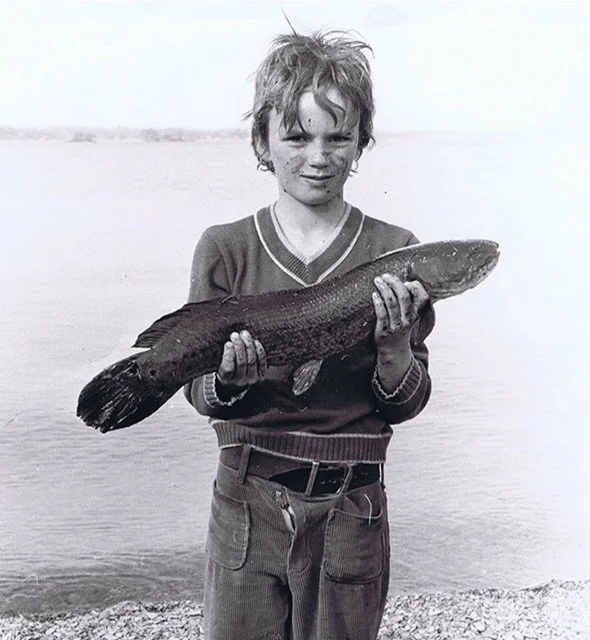
Young Mark Mattson
And in my experience, that is true for everyone I know who defends water. Every Waterkeeper, musician, painter, writer, filmmaker, teacher, philanthropist, and business leader who believes water is worth defending. Each has their own personal reason. Their Watermark.
When you find your story—your unique Watermark—two things happen. First, you realize your reason for caring is unique, deeply personal, and emotional. Secondly, you realize you need to act, learn, participate, and protect your water. The water you love needs you.
I became a Waterkeeper because sewage overflows into the St. Lawrence River released needles, condoms, and bacteria that threatened everything I loved about the waters around Wolfe Island. My power and passion came from this personal story. So, why does the water need your protection?
Because some water body, somewhere, is part of who you are. To do harm to your water body is to do harm to yourself.
It’s not a statistic. It’s not a fact. It’s a story. It’s your Watermark.
🌊 Your Actions: Translating Your Watermark into Change
Finding your personal Watermark is just the beginning. It is the fuel for action, and it is the necessary step to bridge the gap between what we know (water is life) and what we do (pollute it). We must take concrete steps to protect the waters we love.
Here are four actions you can take to protect the water you love:
1. Identify and Share Your Watermark 🌊
Find your unique, personal story about a body of water that shaped you. Write it down, talk about it, and share it by submitting a Watermark.
2. Re-engage and Reclaim Your Water 🧭
There are lots of ways to connect with water: swimming, paddling, fishing, or simply sitting on the shores are all ways to engage with your local water. Observe it, photograph it, and learn its current status. This engagement establishes a visible presence that directly challenges the normalization of pollution.
3. Do Not Tolerate Pollution and Mobilize Change 📣
Become the eyes and ears of the river. If you see sewage, toxic runoff, or debris, you can report pollution in a number of different ways. By using the pollution report feature on VAST, or by contacting your local municipality, provincial ministries, or your regional Waterkeeper organization, you can mobilize change.
4. Engage with Local Representatives ☑️
Contact your elected local representatives. Connect with them about protecting your community’s local waters. This helps support the reinstatement of robust environmental laws and science-based monitoring that ensures clean water is the rule, not the exception.
Some of the most powerful movements start at the grassroots. Local-level changes across watersheds help improve the health of our waters for everyone. Even small actions can ripple into a larger impact across the watershed. Find your personal watermark, and a swimmable, drinkable, fishable future will become possible again.